What Does White Smoke from a Diesel Engine Mean?
White smoke from a diesel engine can mean something minor or something serious. Learn how to tell the difference and when to stop running your equipment before the damage gets worse.
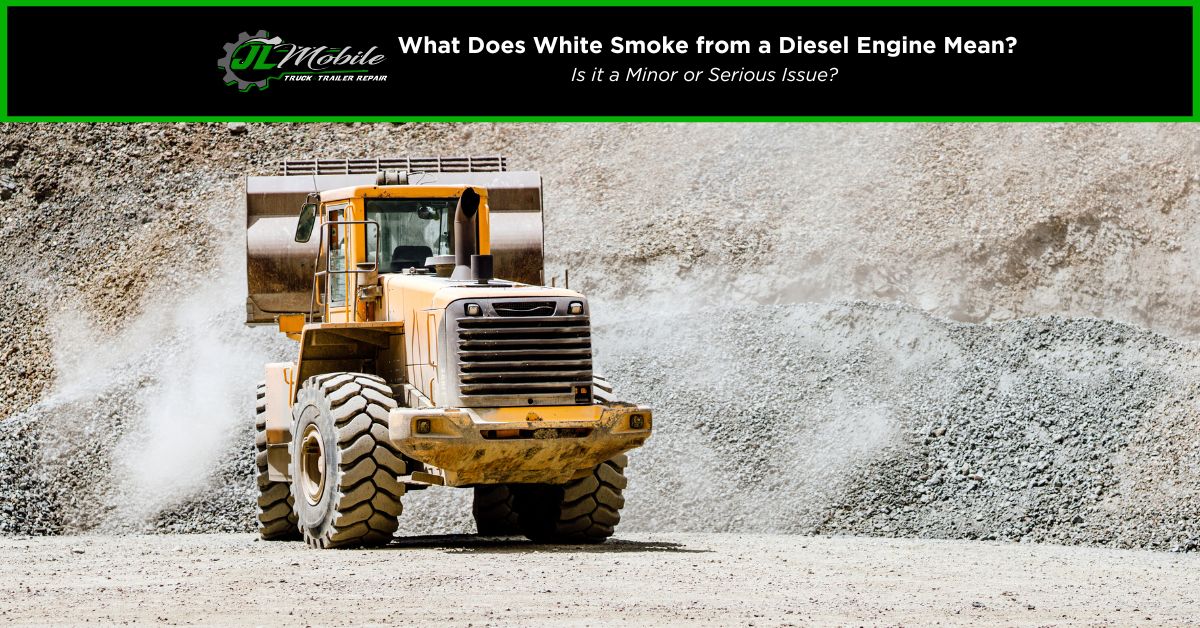
White smoke coming from a diesel exhaust tends to trigger one of two reactions. Some operators wave it off as a normal cold-start condition and keep moving. Others immediately worry something is wrong. The truth is that both reactions can be right, and knowing the difference is what keeps a manageable repair from turning into a destroyed engine.
Unlike black smoke, which almost always points to a fuel and air problem, white smoke has several distinct causes. Some are harmless. Some are urgent. Here is how to read what your engine is telling you.
What White Smoke Actually Means
White smoke is your engine expelling something it cannot fully combust. That something could be water vapor, coolant, or raw fuel — and each one points to a different problem with a different level of urgency. The cause, not the smoke itself, is what determines how quickly you need to act.
1. Cold Start Water Vapor
The most common and least alarming cause is moisture on a cold start. When a diesel engine is cold and combustion temperatures are low, moisture in the air and fuel system gets expelled as white vapor through the exhaust. It typically clears within a few minutes of warm-up and carries no odor. If this is what you are seeing, there is nothing to be concerned about.
2. Coolant Entering the Combustion Chamber
The situation changes when white smoke appears after the engine has fully warmed up or persists well beyond the normal warm-up window. At that point, the most likely culprit is coolant leaking into the combustion chamber. This happens when a head gasket fails, a cylinder head cracks, or in severe cases when the engine block itself develops a crack. Coolant that seeps past a blown gasket into the cylinder gets burned during combustion and exits as thick white or gray smoke. The exhaust will often carry a sweet, almost syrupy smell, which is the antifreeze burning off. That smell is one of the most reliable on-site diagnostic clues a driver or operator can use without tools.
Running an engine with coolant in the combustion chamber is one of the fastest ways to cause catastrophic damage. The coolant contaminates the engine oil, stripping away its ability to lubricate internal components. It also causes combustion temperatures to spike unevenly, accelerating wear on pistons, rings, and cylinder walls. What starts as a blown head gasket can become a seized engine in a matter of hours if the equipment keeps running.
3. Injector Failure
A stuck-open or leaking injector can allow raw fuel to pass through the cylinder without fully combusting, which exits as white or light gray smoke, particularly at startup. This is easy to confuse with cold-start vapor, but injector-related smoke tends to linger longer and may come with a rough idle or a noticeable fuel smell in the exhaust.
4. Incorrect Injection Timing
Timing set too far advanced or retarded prevents fuel from combusting at the right moment in the compression cycle. The result is unburned or partially burned fuel exiting as white smoke, along with reduced power and rough running. Timing issues require professional diagnosis since the symptoms overlap closely with other conditions, including injector problems and early head gasket failure.
When to Stop and Make the Call
If white smoke does not clear after warm-up, check your coolant level immediately. A level that has dropped without an obvious external leak is a strong indicator the coolant is going somewhere it should not be. At that point, shut the equipment down. Continuing to operate it is not worth the risk.
At JL Mobile, our ASE Master Certified technicians diagnose white smoke issues on semi trucks, tractors, backhoes, heavy construction equipment, and diesel RVs across Joplin and the Four States area. We bring diagnostic equipment to the job site, and when your equipment cannot move, our 24/7 heavy-duty towing gets it to us without additional damage.
Call (417) 438-9461 or stop by 120 N Prigmor Ave, Joplin, MO. White smoke is worth taking seriously. We will help you figure out exactly why it is there.