Why Is My Diesel Engine Blowing Black Smoke?
Black smoke from a diesel engine is never just cosmetic. Learn the most common causes — and what to do before a smoke problem turns into a serious breakdown.
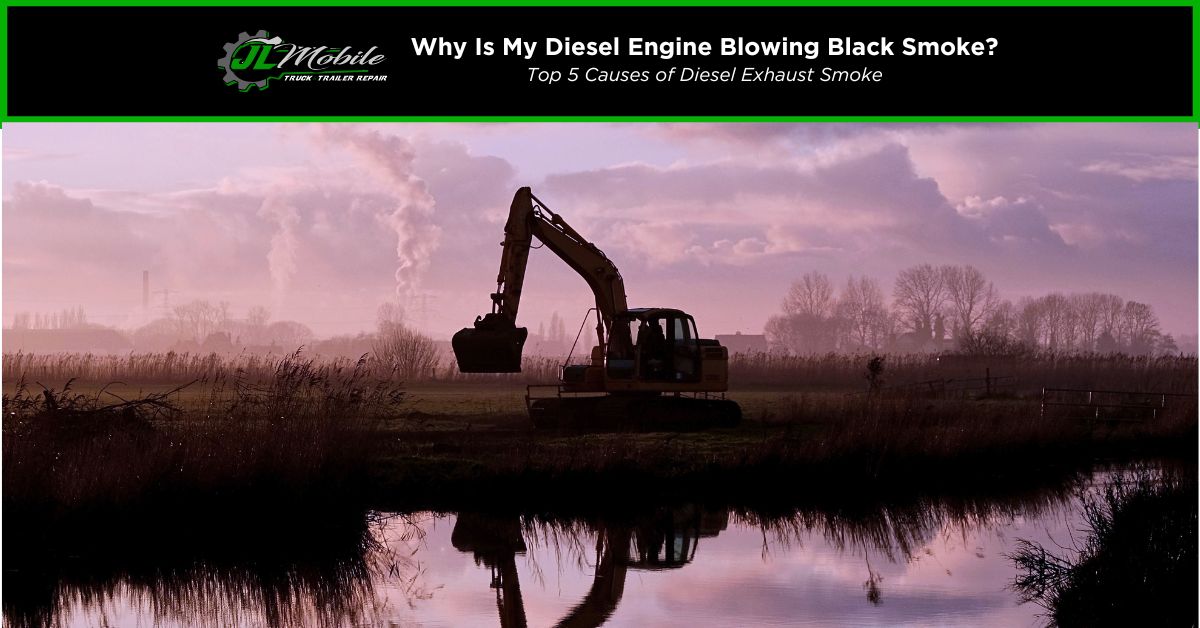
Black smoke rolling from a diesel exhaust is hard to ignore — and it shouldn't be. While a brief puff at startup or hard acceleration is normal, thick or persistent black smoke is your engine signaling that something is wrong with the combustion process.
The good news: black smoke has identifiable causes. The bad news: most of them get worse — and more expensive — the longer you let them go. Here's what's most likely causing it on your semi, tractor, backhoe, or diesel RV.
What Black Smoke Actually Means
Black smoke is unburned or partially burned fuel exiting the exhaust. That means somewhere in the combustion process, your engine is getting too much fuel, not enough air, or both. Pinpointing which one narrows the problem fast.
1. Clogged Air Filter
This is the simplest cause and the first place to check. A severely restricted air filter starves the engine of the oxygen it needs for complete combustion. The fuel goes in but can't burn cleanly — and the excess exits as black smoke. On heavy equipment and tractors working in dusty conditions, air filters can clog faster than expected.
2. Failing Fuel Injectors
Worn or dirty injectors can over-fuel the engine or deliver a poor spray pattern, leading to incomplete combustion. If you've already checked the air filter and you're still seeing heavy black smoke — especially alongside a rough idle or loss of power — injectors are a likely culprit.
3. Turbocharger Problems
The turbo's job is to force more air into the combustion chamber. When it starts to fail — through worn bearings, oil leaks, or damaged vanes — it can't deliver adequate boost. Less air means the fuel-to-air ratio goes out of balance, and black smoke follows. A failing turbo often comes with a noticeable whine or loss of power under load.
4. EGR Valve Issues
The exhaust gas recirculation (EGR) valve, found on newer diesel equipment, routes exhaust gases back into the intake to reduce emissions. When it sticks open or gets clogged with carbon buildup, it disrupts the air-fuel mixture and contributes to black smoke. EGR problems are especially common on higher-mileage semis and equipment.
5. Incorrect Injection Timing
If fuel is injected into the cylinder at the wrong moment — too early or too late relative to compression — it won't combust efficiently. Timing issues can stem from a worn injection pump, sensor failures, or mechanical wear. The result is incomplete combustion, power loss, and black smoke that doesn't clear up regardless of load.
When to Stop Waiting and Make the Call
If the smoke is thick, constant, or getting worse — don't keep running the equipment. Persistent incomplete combustion accelerates carbon buildup, damages injectors and valves, and shortens the lifespan of major components. What looks like a minor issue can mask a deeper problem that only gets worse under load.
At JL Mobile, our ASE Master Certified technicians diagnose black smoke issues on semi trucks, tractors, backhoes, heavy construction equipment, and diesel RVs across Joplin and the Four States area. We come to you — no flatbed required for most diagnostic calls. And when your equipment is already down, our 24/7 heavy-duty towing has you covered.
Call (417) 438-9461 or stop by 120 N Prigmor Ave, Joplin, MO. Black smoke is your engine asking for help — don't make it ask twice.